Kratom · Sold as a supplement
The gas-station
“supplement” that
is really an opioid.
Kratom is sold legally across most of the United States as a wellness and energy product — powders, capsules, and extracts on convenience-store shelves. But its active compounds act on the brain's opioid receptors, and the FDA characterizes kratom as an opioid, not merely a plant.
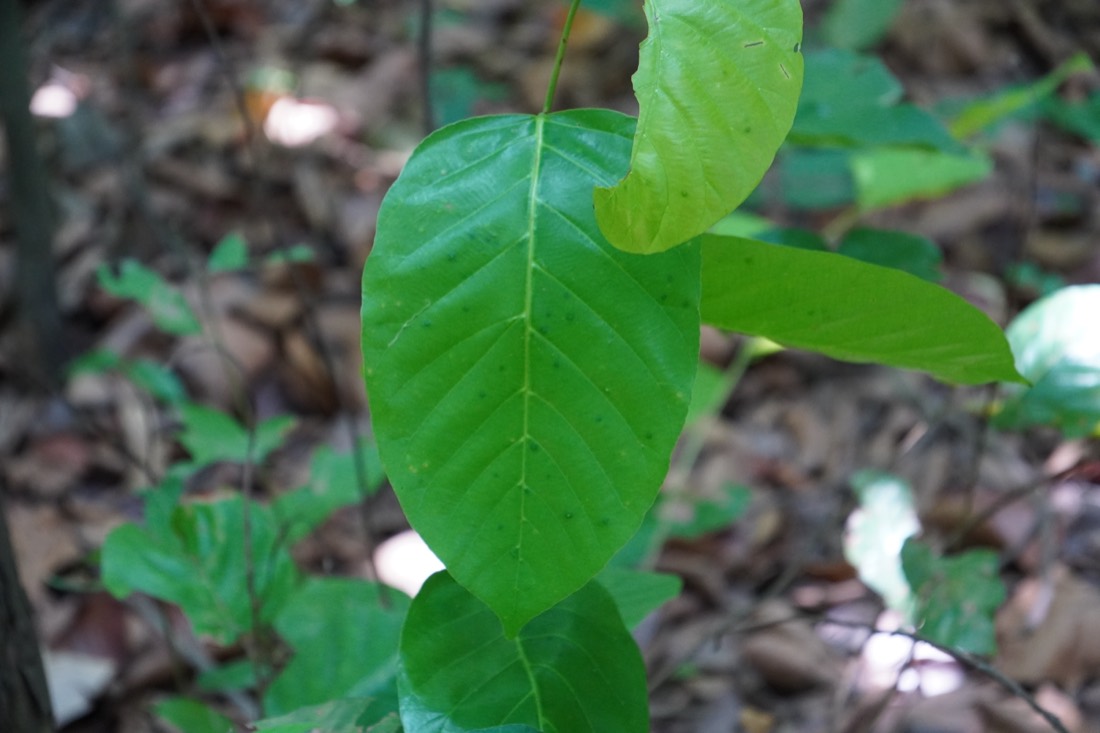
Photo: Ishtiak Abdullah, via Wikimedia Commons (CC BY-SA 4.0).
By the numbers · U.S. data
Sources: National Poison Data System analysis, 2015–2025; CDC SUDORS, 2016–17. See references.
In an emergency
- Emergency: 911
- Poison Control: 1-800-222-1222
- Suicide & Crisis Lifeline: 988
Regular kratom use can lead to opioid-type dependence and withdrawal. If you're planning to cut down or stop, talk to a clinician or Poison Control first. U.S. numbers shown.
What is Kratom?
A tree with opioid pharmacology
Kratom (Mitragyna speciosa) is a tree native to Southeast Asia. Its leaves contain mitragynine and 7-hydroxymitragynine (7-OH), which bind to the same mu-opioid receptors in the brain as morphine and other opioids.[2]
At low doses users report stimulant-like effects; at higher doses the effects are opioid-like, including sedation and pain relief.[1]
Legal, and widely available
Kratom is sold legally in most U.S. states — powders, capsules, and extracts at gas stations and convenience stores — marketed as a wellness, energy, or mood product.
The FDA warns consumers not to use kratom and states it is not approved for any medical use, characterizing it as an opioid rather than merely a plant product.[2]
Health Risks and Side Effects
Reported Harms
- Liver toxicity
- Seizures
- Substance use disorder
- Nausea, sweating, agitation
FDA warnings[2]
Opioid Dependence & Withdrawal
- Tolerance and escalating doses
- Physical dependence
- Opioid-type withdrawal: sweating, vomiting, pain, anxiety
- Does not appear on standard opioid drug screens
Dangerous Interactions
Because kratom acts on opioid receptors, combining it with other opioids, benzodiazepines, or alcohol may increase the risk of respiratory depression. Most kratom-related deaths in U.S. surveillance data involved additional substances, though those data alone do not establish each substance's contribution.[1, 5]
A Decade of Rising Harm
Poison-center figures are reported calls, not confirmed diagnoses or a complete national count. Death figures come from separate surveillance systems.[1, 5]
Annual kratom exposures reported to U.S. poison centers rose roughly 1,200% from 2015 to 2025.
Reported poison-center exposures in 2025, up from 258 in 2015.
Deaths recorded among these poison-center exposure reports; about 80% also involved other substances.
Of 152 kratom-positive overdose deaths in CDC data (2016–17), kratom was determined to be a cause in 91; 7 involved kratom alone.
Key Findings
Sharp, sustained rise. An analysis of the National Poison Data System found kratom exposures climbing from 258 in 2015 to 3,434 in 2025 — a roughly 1,200% increase in reported exposures.[5]
Deaths are mostly polysubstance. Of 233 kratom-related deaths over the decade, about 80% involved other substances. In earlier CDC data, kratom was determined to be a cause of death in 91 of 152 kratom-positive overdose deaths, with 7 involving kratom alone.[1, 5]
Withdrawal is easily missed. Standard opioid drug screens generally do not detect kratom's alkaloids, so its opioid-type withdrawal can be mistaken for an anxiety or agitation crisis in people who never considered a "supplement" to be a drug.[2, 6]
7-OH and the 2026 Federal Action
What is 7-OH?
7-hydroxymitragynine (7-OH) is a minor alkaloid in the kratom leaf that is reported to be considerably more potent at opioid receptors than mitragynine. Concentrated 7-OH products — tablets, gummies, and shots — have appeared on the U.S. market only recently.[3]
The FDA states 7-OH products have not been shown to be safe or effective and reports associations with respiratory depression, seizures, liver toxicity, and deaths.[3]
The DEA action (July 2026)
On July 1, 2026 the DEA issued notices of intent to temporarily place products containing more than 0.05% 7-OH, along with three synthetic derivatives, into Schedule I of the Controlled Substances Act — a notice of intent, not yet a completed scheduling.[4]
Public-health commentators note the limit of that step: it targets concentrated 7-OH products, while ordinary kratom leaf — which can also cause dependence — remains legal in most states.[6]
Addiction physician Andrew Kolodny argues that when an opioid becomes readily available and its addictive potential is minimized, more people use it, more develop opioid use disorder, and related harms follow.
Summarizing an opinion by Andrew Kolodny, MD, in The Washington Post, July 2026[6]
Get Help and Learn More
Frequently Asked Questions
- Is kratom an opioid?
- The FDA characterizes kratom as an opioid, not merely a plant. Its main active compounds, mitragynine and 7-hydroxymitragynine (7-OH), bind to the same mu-opioid receptors in the brain as morphine and other opioids.
- Is kratom legal in the United States?
- Kratom is legal in most U.S. states and sold as powders, capsules, and extracts. The FDA warns against its use and has not approved it for any medical purpose. In July 2026 the DEA issued notices of intent to place concentrated 7-OH (above 0.05%) and three synthetic derivatives in Schedule I.
- Is kratom addictive?
- Yes. Because kratom acts on opioid receptors, regular use can lead to tolerance, physical dependence, and opioid-type withdrawal. The FDA lists substance use disorder among its risks.
- What are kratom withdrawal symptoms?
- Kratom withdrawal resembles opioid withdrawal: sweating, nausea and vomiting, muscle aches, anxiety, and insomnia. Because kratom is not detected on standard opioid drug screens, this withdrawal is sometimes mistaken for an anxiety crisis.
- What is 7-OH?
- 7-hydroxymitragynine (7-OH) is a minor kratom alkaloid reported to be considerably more potent at opioid receptors than mitragynine. Concentrated 7-OH products (tablets, gummies, shots) are recent, and in July 2026 the DEA moved to schedule products containing more than 0.05% 7-OH.
- How many people have died from kratom?
- A National Poison Data System analysis recorded 233 kratom-related deaths from 2015–2025, about 80% involving other substances. Separately, CDC data (2016–17) found kratom was a cause of death in 91 of 152 kratom-positive overdose deaths, with 7 involving kratom alone.
References
- Olsen EO, O'Donnell J, Mattson CL, Schier JG, Wilson N. Notes from the Field: Unintentional Drug Overdose Deaths with Kratom Detected — 27 States, July 2016–December 2017. MMWR Morb Mortal Wkly Rep. 2019;68(14):326–327. cdc.gov
- U.S. Food and Drug Administration. FDA and Kratom. fda.gov
- U.S. Food and Drug Administration. Products Containing 7-OH Can Cause Serious Harm. fda.gov
- U.S. Drug Enforcement Administration. DEA to Temporarily Schedule 7-OH and Related Substances to Protect Public Safety (July 1, 2026). dea.gov
- National Poison Data System analysis of U.S. kratom exposures, 2015–2025 (258 → 3,434 annual exposures; ~1,200% increase; 233 deaths, ~80% polysubstance). Reported by CNN, March 27, 2026. cnn.com
- Kolodny A. "'It's an opioid': My patients are becoming addicted to this 'supplement.'" The Washington Post, opinion, July 14, 2026.
Published March 2025 · Last reviewed and updated July 19, 2026. Content compiled from these public sources for education; it has not undergone independent clinical review. See About & Editorial Policy and our Disclaimer.